

Why choose Avenir Renovations?
Technical diagnosis: insulate the floor or the roof?
The first question asked during the visit to Marche-en-Famenne is simple: how do you use your attic? The answer completely determines the insulation strategy and the achievable U-values.
Unfinished attic: floor insulation
If your attic remains a storage space or an unheated volume, the most effective and economical solution is to insulate the floor. An insulating mat is created on the attic floor that prevents the heat from your living spaces from dissipating into an unused volume. This is the technique that offers the best return on investment for the same thickness: with 20 to 24 cm of blown mineral wool, a thermal resistance R greater than 6 m²K/W is achieved, well above the minimum threshold required for Walloon grants.
Convertible attic: insulation by the slope
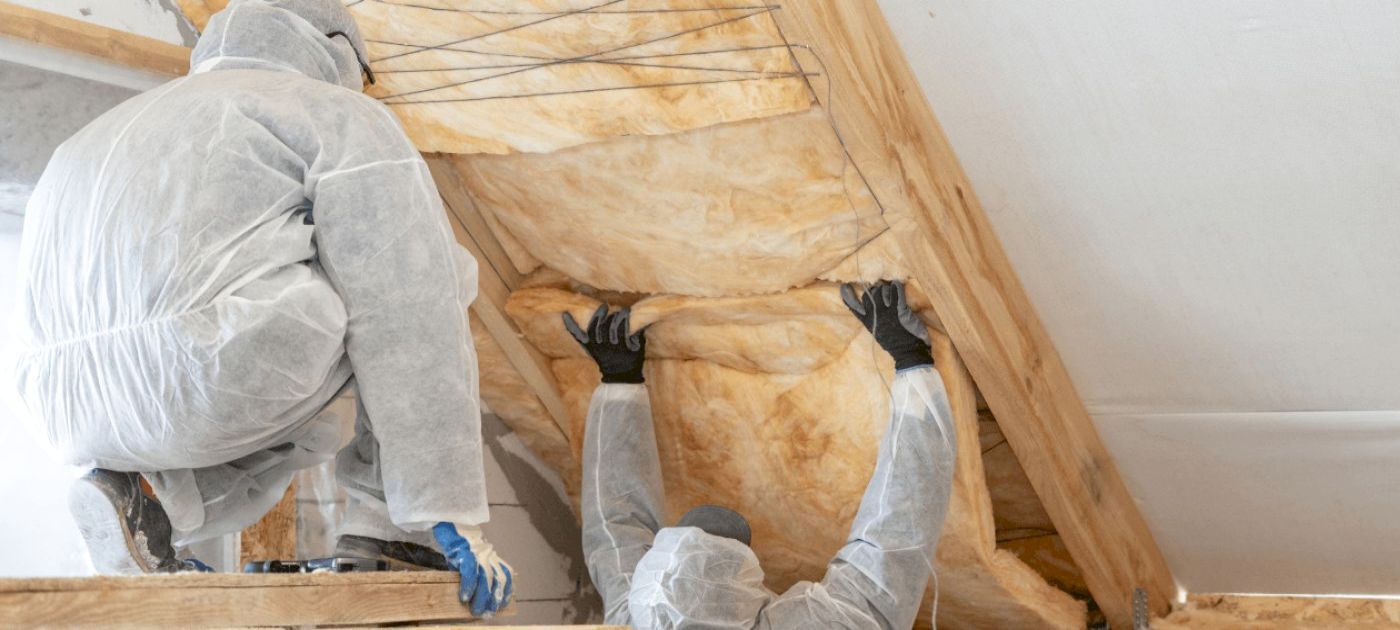
If the volume is intended to be heated — even without immediate fit-out — insulation must be done directly under the roof, following the slopes. This technique is technically more demanding: each joint, each connection around a duct or a roof window must be treated precisely to avoid thermal bridges. This is where the difference between a installer and a qualified insulator is measured concretely on the energy performance certificate.
In both cases, we check the condition of the joists and the framework before any intervention. Insulating a damp or degraded structure would be counterproductive. In Marloie or Aye, many old roofs do not have under-roofing. We then adapt our methods to preserve the necessary ventilation for the health of the wood, without exposing the insulation to external moisture. Consult our online tool for a first estimate: attic insulation prices in Belgium.
The steps of the project
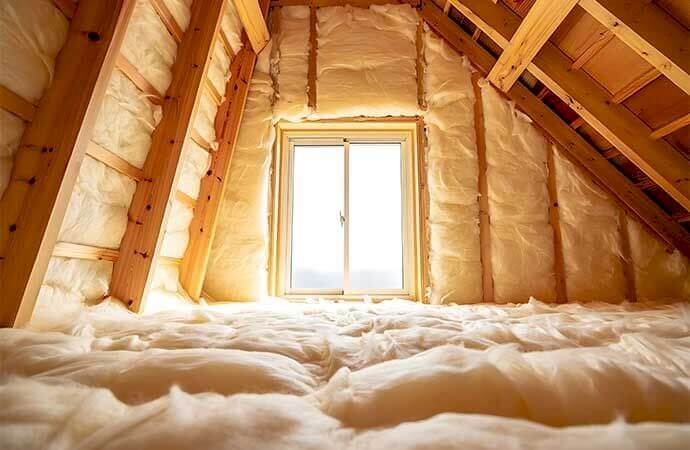
Properly insulating an attic starts with a good diagnosis: type of attic, access, potential humidity, suitable technique. Here’s how we proceed in Marche-en-Famenne, from the survey to the completion.
The choice of insulators: conductivity, phase shift, and Walloon grants
Choosing the right insulation optimizes thermal comfort, energy savings, and summer performance. Mineral wool, PIR panels, or wood fiber: each solution meets specific constraints of thickness, insulation, and phase shift for effective and durable renovation.
Rock wool (λ = 0.035 to 0.040 W/mK) and glass wool (λ = 0.032 to 0.044 W/mK) are the reliable choices for the vast majority of configurations in Marche-en-Famenne. Their quality-price ratio is solid, their fire resistance excellent, and their implementation well mastered. To achieve the target Uw value of 0.24 W/m²K required by Walloon grants for roof insulation, approximately 16 to 18 cm of rock wool must be placed between the rafters, supplemented by counter insulation if the thickness between rafters is insufficient.
When the available space between rafters is limited — a common situation in the old roofs of Famenne — rigid polyurethane panels (PIR, λ = 0.022 to 0.026 W/mK) offer the best thermal performance at equal thickness. With 12 cm of PIR, the same R-value is achieved as with 18 cm of mineral wool. This thickness gain preserves the usable height under slopes and facilitates the passage of technical ducts. The material cost increase is real but justified as soon as dimensional constraints impose it.
Wood fiber (λ = 0.038 to 0.042 W/mK) is not the most efficient solution in pure thermal resistance, but it excels in a criterion often overlooked: thermal lag. This parameter measures the delay with which external heat penetrates the wall into the interior. With 20 cm of wood fiber, the lag reaches 10 to 12 hours — concretely, the heat accumulated on the roof during peak afternoon hours only enters the space under the roofs at the beginning of the night, when natural ventilation is sufficient to evacuate it. For attics exposed to the south or southwest on the Famenne plateau, this is a major asset in summer.
How much does attic insulation cost in Marche-en-Famenne (price ranges including VAT)
Amounts vary based on surface area, access, thickness, and technique. A detailed quote always follows a visit.
| Item | Price indication (including VAT) |
| Blown insulation for lost attics (cellulose/wool), per m² | 22 to 45 €/m² |
| Attic floor – panels/rolls between joists, per m² | 25 to 55 €/m² |
| Under rafters (2 crossed layers + vapor barrier), per m² | 40 to 90 €/m² |
| Raise + technical floor (storage area), per m² | 25 to 60 €/m² |
| Insulated attic hatch (supply + installation) | 180 to 450 € |
| Caps for spots / casing around duct (fixed price) | 80 to 250 € |
| Air tightness test (optional) | 350 to 700 € |
Budget tip: insulating the floor of an unheated attic is cheaper than insulation under rafters — and the impact on the bill is immediate.
Sarking: insulation by the outer layer
Principle and advantages of sarking
Sarking involves placing rigid insulating panels directly on the outer layer of the framework, under the covering. Unlike insulation between rafters, sarking structurally eliminates thermal bridges at the level of the rafters themselves — which represent 10 to 15% of the roof surface and constitute as many areas of heat loss in conventional insulation. The thermal continuity is total, from the eaves to the ridge. It is the reference technique when the roof needs to be repaired or replaced: the two projects are combined.
Achievable U-values and PEB compatibility
With 14 cm of PIR panels in sarking, a U-value of less than 0.17 W/m²K is achieved — well below the threshold of 0.24 W/m²K for standard Walloon grants, and compatible with the requirements of increased grants and the performance level PEB A. The Avenir Rénovations team sizes the thickness according to your PEB certificate goal and the targeted grants, not just the immediate budget.
Management of thermal bridges and air tightness
Critical thermal bridges in a Famennois attic
In the old roofs of Marche-en-Famenne, the most common thermal bridges are located at the level of the sablières — the horizontal wooden piece on which the rafters rest at the foot of the slope. This is where the insulation between the rafters ends, often leaving an untreated area of 20 to 30 cm wide that runs along the entire perimeter of the roof. This linear thermal bridge generates condensation in winter on the inner face of the vertical posts and gradually degrades the wood. Our specialists systematically treat this junction with a specific insulating lining before the finishing touches are applied.
The vapor barrier: absolute continuity
The vapor barrier, installed on the warm side of the insulation, prevents moisture produced by daily life — showers, cooking, breathing — from migrating into the insulating mass. A poorly sealed vapor barrier at a membrane joint, around a duct or an access hatch is enough to create a condensation zone that degrades the insulation and the structural wood over several years. The Avenir Rénovations team tapes each connection with suitable sealing tapes and treats all singular points without exception.
Blower Door test: checking what the eye cannot see
The Blower Door test (or air permeability test) measures the air leakage rate through the insulated envelope under a standardized pressure of 50 Pa. It allows for the detection of sealing defects that are invisible to the naked eye — a forgotten seal around an electrical cable, an insufficiently adhered vapor barrier joint — before the finishing touches are applied. For projects aiming for an A energy label or increased grants, this test becomes an essential validation tool. We can integrate it into the site upon request.
Impact on the energy performance certificate and Walloon grants
Measurable energy performance gain on primary consumption
In Wallonia, the primary energy consumption of a dwelling is expressed in kWh/m².year on the energy performance certificate. Transitioning from an uninsulated attic to a roof with U = 0.24 W/m²K typically saves 15 to 25 kWh/m².year on total primary consumption, depending on the roof area and the existing heating system. For a 150 m² house in Marche, this often represents one or two levels of energy performance score — with a direct impact on rental value and resale value of the property.
Walloon grants: threshold U values to respect
Grants for roof insulation in Wallonia are conditioned on achieving specific U values. The standard threshold for the basic grant is U ≤ 0.24 W/m²K. Increased grants are available for U ≤ 0.15 W/m²K. These values must be certified by the installer and can be verified as part of a housing audit. Our specialists size the insulation aiming for the most advantageous thresholds according to your situation, incorporating the grant into the calculation of overall return on investment.
Return on investment: 3 to 7 years depending on the configuration
The return on investment for attic insulation in Marche-en-Famenne depends on several variables: insulated area, type of insulation, heating system, energy prices. Generally, insulating the floor of an unconverted attic pays off in 3 to 4 years. Insulating the slopes with sarking, which is more expensive, amortizes in 5 to 7 years — but the gain in energy performance value and summer comfort exceeds the simple energy equation.
Why choose Avenir Rénovations in Marche-en-Famenne?
A complete mastery of the energy envelope
Our teams know the local building. We are not just simple insulators: we work on the entire thermal envelope, from preparing the substrate to removing old materials, including treating thermal bridges and documentation for grants. Each project is managed from A to Z, without uncontrolled subcontracting.
Intervention throughout the greater Marche, clean site guaranteed
We operate throughout the greater Marche — Waha, Marloie, Aye, Hargimont, On — as well as in neighboring municipalities: Rochefort, Ciney, Hotton, and Nassogne. Cleanliness on site is a priority: we use industrial vacuum cleaners to leave your access impeccable after intervention.
Common issues and our solutions
Thermal bridge at the level of the wall plates: the forgotten area of insulation
In the old roofs of Famenne, the insulation between rafters often stops at the level of the wall plate, leaving a strip of 20 to 30 cm completely untreated at the foot of the slope. This linear thermal bridge runs around the entire perimeter of the roof and generates visible condensation in winter on the inner face of the vertical posts. On the energy performance certificate, these linear leaks degrade the score more than one might think. The solution involves a specific insulating lining at the foot of the rafter, coordinated with the treatment of the vapor barrier to avoid any discontinuity.
Condensation between the strips of vapor barrier membrane
A vapor barrier hastily installed — strips insufficiently overlapped, joints not glued, unsealed perforations around ducts — allows water vapor to pass into the cold zone between the insulation and the roof. The vapor condenses on the wood of the rafters or on the cold face of the waterproofing membrane, forming an invisible but devastating moisture veil over the long term. Mold settles in, the wood darkens, and the mechanical resistance of the framework gradually decreases. Our specialists seal each membrane joint with certified sealing tapes and document the treated unique points so that the result is verifiable.
Settling of blown insulation in lost attics
Loose blown wool, poorly sized or installed without support in hard-to-access attics, gradually settles under the effects of hygrometric and thermal cycles of the Famenne attics. The effective thickness can lose 20 to 30% in a few years, causing the actual thermal resistance to drop below the declared values — and grant thresholds. The investment loses its effectiveness without the owner noticing. We size the installed thickness by incorporating predictable long-term settling, and use materials whose density ensures dimensional stability over time.
Frequently Asked Questions
Is it better to insulate the attic floor or directly under the roof slope?
The answer depends on the use of the attic and the target U values. If the space remains unheated and is used only for storage, insulating the floor is the most economical solution with the best return on investment. If the volume is or will be heated, insulation should be done under the slopes, with particular attention to thermal bridges at the wall plates and the air tightness of the vapor barrier. In both cases, our specialists calculate the achievable U values and the corresponding Walloon grants.
What U value must be achieved to benefit from Walloon grants?
The basic grant for roof insulation in Wallonia is conditioned on U ≤ 0.24 W/m²K. Increased grants are available for U ≤ 0.15 W/m²K. These values typically correspond to 16-18 cm of mineral wool, 12 cm of PIR, or 14 cm of PIR sarking depending on the technique. The Avenir Rénovations team systematically sizes the insulation aiming for the most advantageous grant threshold based on your configuration.
In how many years can attic insulation pay for itself?
Insulating the floor of an unconverted attic is generally recouped in 3 to 4 years on heating bills. Insulation by the slopes or in sarking, which is more expensive, amortizes in 5 to 7 years — but the gain in energy performance certificate (EPC) value adds to the calculation: moving from a D score to a B can represent several tens of thousands of euros in added value when reselling on the market. The reduced VAT rate of 6% and Walloon grants further shorten this payback period.
What is a thermal bridge and why is it critical in an attic?
A thermal bridge is a localized area of the envelope where the thermal resistance is significantly lower than that of the rest of the wall — typically a rafter, a wall plate, or the junction between a wall and a roof. These areas concentrate heat losses and create cold spots where condensation accumulates in winter. In an attic, thermal bridges at the wall plates and around roof windows are the most common and impactful on the EPC score. Our specialists map them during the diagnosis and systematically address them before installing the main insulation.
Do you want to insulate your attic in Marche-en-Famenne?
Don't let your heat escape through the roof. Contact us today for a thermal analysis of your attic and a detailed quote including target U values, applicable Walloon grants, and the return on investment calculated based on your actual consumption.
Agency Avenir
Rénovations
for Attic insulation in Marche-en-Famenne
An expert to take charge of your renovation projects and guarantee deadlines, budgets and quality of all services.


Attic insulation in Marche-en-Famenne and everywhere in France


Other work in Marche-en-Famenne
- Home renovation work in Marche-en-Famenne
- Masonry work in Marche-en-Famenne
- Apartment renovation in Marche-en-Famenne
- Bathroom renovation in Marche-en-Famenne
- Painting work in Marche-en-Famenne
- Home extension in Marche-en-Famenne
- Joinery installation work in Marche-en-Famenne
- Interior renovation work in Marche-en-Famenne
- Kitchen renovation in Marche-en-Famenne
- Attic renovation in Marche-en-Famenne
- Insulation renovation work in Marche-en-Famenne
- Facade renovation in Marche-en-Famenne
- Renovation work in Marche-en-Famenne
- Energy renovation in Marche-en-Famenne
- Outdoor fit-out in Marche-en-Famenne
- Terrace construction in Marche-en-Famenne
- Interior fit-out in Marche-en-Famenne
- Roof renovation in Marche-en-Famenne
- Interior flooring in Marche-en-Famenne
- Exterior renovation in Marche-en-Famenne
- Installation of frames in Marche-en-Famenne
- Fit-out of accessible bathrooms in Marche-en-Famenne